
Writing a research paper is one of the most demanding tasks in academic life. Between finding credible sources, organizing your argument, formatting citations, and actually writing clearly — it’s a lot to manage at once. The good news is that in 2026, there are more useful writing and research tools than ever before, and they’ve gotten genuinely good at helping with the heavy lifting.
This guide is for students, researchers, and academics who want to work smarter. Whether you’re writing your first literature review or your fifth journal submission, these tools can save you hours and make your final paper significantly better.
Writing a high-quality research paper takes time, careful planning, and attention to detail. From finding credible sources and organizing references to improving grammar, citations, and academic writing style, the process can be challenging for students, researchers, and professionals alike. In 2026, modern writing and research tools have made these tasks faster and more efficient, helping users focus on developing strong ideas instead of spending hours on formatting and editing.
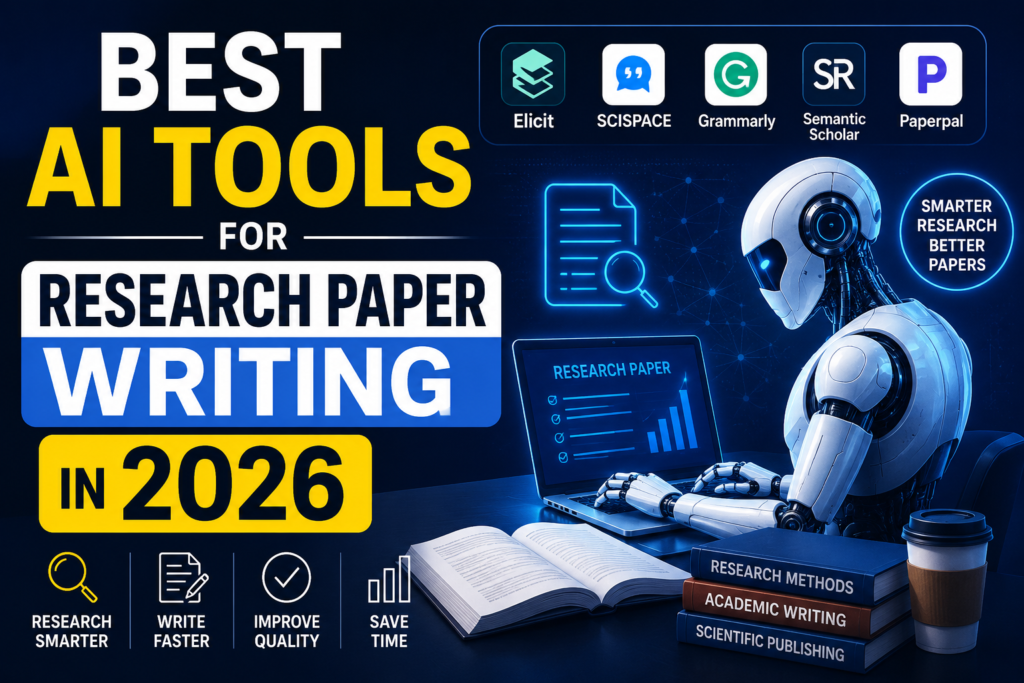
The best AI tools for research paper writing can assist with literature reviews, academic writing, paraphrasing, citation management, plagiarism detection, grammar correction, and document organization. While these tools can significantly improve productivity, they should be used as writing assistants rather than replacements for original research, critical thinking, and proper academic practices. Whether you’re preparing a university assignment, journal manuscript, thesis, dissertation, or conference paper, this guide highlights the best AI tools for research paper writing in 2026, comparing their features, strengths, pricing, and ideal use cases to help you choose the right solution for your academic needs.
- Check now: Best AI Tools for Research in 2026
Why Research Paper Writing Needs Better Tools
The traditional research process looks something like this: search Google Scholar, open twenty tabs, try to read everything, lose track of what came from where, paste notes into a document, and spend the last two days frantically formatting citations.
Sound familiar?
The problem isn’t a lack of effort — it’s that the process is fragmented. You’re jumping between a search engine, a PDF reader, a notes app, a writing tool, and a citation manager all at the same time. Good research tools fix this by bringing parts of that process together or making individual steps dramatically faster.
In 2026, the best tools handle things like:
- Finding and summarizing relevant academic papers
- Organizing your notes and sources in one place
- Helping you write clearer, better-structured drafts
- Catching grammar, style, and clarity issues
- Generating properly formatted citations automatically
- Checking your work for plagiarism
Let’s go through each category and the best tools in each.
1. Research Discovery Tools
Before you write a single word, you need sources. These tools go well beyond Google Scholar.
Semantic Scholar
Semantic Scholar is a free academic search engine built by the Allen Institute for AI. What sets it apart is how it surfaces papers — not just by keyword match, but by relevance to the actual meaning of your query. Search for “urban heat island effect on public health,” and it finds papers that genuinely discuss that intersection, not just papers that contain those individual words.

It also shows you citation counts, influential references, and a summary of each paper’s key findings right on the results page. For literature reviews especially, this saves enormous amounts of time.
Best for: Finding papers, mapping a research field, literature reviews
Cost: Free
Connected Papers
Connected Papers is a visual tool that maps the relationship between academic papers. You paste in one paper you know is relevant, and it generates a graph showing related works — papers that cite it, papers it cites, and papers that share significant citation overlap.

For example, if you’re writing a paper on machine learning applications in climate modeling and you find one strong paper on the topic, Connected Papers can show you the entire cluster of related work in that space. This is genuinely one of the fastest ways to do a literature review.
Best for: Literature reviews, finding the key papers in a field, understanding how a body of research is connected
Cost: Free for basic use, paid plan for heavier use
Elicit
Elicit is a research assistant that helps you answer specific research questions using academic papers. You type a question — not a search query, but an actual question like “What interventions reduce anxiety in university students?” — and it pulls relevant papers and extracts key findings from each one in a structured table.

This is especially useful when you need to compare findings across studies, which is exactly what a literature review requires. Instead of reading fifteen abstracts and taking notes manually, Elicit gives you a summary table you can review in minutes.
Best for: Literature reviews, finding answers to specific research questions, comparing findings across studies
Cost: Free tier available, paid plan for more queries
2. Note-Taking and Source Organization Tools
Finding papers is only half the battle. Keeping everything organized so you can actually use it when writing is where most people fall apart.
Zotero
Zotero is the gold standard for reference management and has been for years. It’s free, open-source, and incredibly powerful. You install a browser extension, and whenever you’re on a journal website or Google Scholar, a single click saves the paper to your Zotero library — complete with all its metadata (author, year, journal, DOI, abstract).
When it comes time to write, Zotero integrates directly with Microsoft Word and Google Docs. You insert citations with a click, and Zotero builds your bibliography automatically in whatever format you need — APA, MLA, Chicago, Vancouver, IEEE, and hundreds of others.
Practical example: You’re writing a paper on renewable energy policy. Over two weeks of research, you save 60 papers to Zotero, organize them into folders by subtopic (solar, wind, policy frameworks, case studies), add brief notes to each, and tag them by methodology. When you sit down to write, everything is searchable, sortable, and ready to cite.
Best for: Managing references, generating citations and bibliographies, organizing large numbers of sources
Cost: Free (with paid storage plans for large libraries)
Notion
Notion has become a go-to tool for researchers who want a flexible workspace. You can build a database of papers, write notes that link to each source, create outlines, and manage your writing project all in one place.
A common setup: a Notion database where each row is a paper, with columns for title, author, year, key argument, methodology, limitations, and relevance to your thesis. Then a separate page for your paper outline, where each section links back to the relevant rows in your database.
It’s more hands-on to set up than Zotero but gives you far more flexibility in how you organize your thinking.
Best for: Researchers who want a custom workspace, project management alongside research, teams collaborating on a paper
Cost: Free for individuals, paid plans for teams
Obsidian
Obsidian is a note-taking tool that uses a local folder of plain text (Markdown) files and lets you link notes together. Its big appeal is the graph view — a visual map of how your notes connect. For researchers building a complex argument across many sources, this can be a powerful thinking tool.
Best for: Deep thinkers, researchers who want to build a personal knowledge base over time
Cost: Free for personal use
3. Writing and Drafting Tools
Once you have your sources organized and your outline ready, the writing itself is where most time goes.
Grammarly
Grammarly remains one of the most useful writing tools for academic work. The browser extension and desktop app check your writing in real time for grammar errors, awkward phrasing, clarity issues, and consistency. The paid version adds tone detection, vocabulary suggestions, and a plagiarism checker.
For non-native English speakers writing in English, Grammarly is particularly valuable. It catches the kinds of errors that native speakers might miss — subject-verb agreement issues, incorrect prepositions, passive voice overuse.
One thing to be aware of: Grammarly sometimes suggests simpler phrasing that isn’t appropriate for formal academic writing. Use its suggestions as a starting point, not gospel.
Best for: Grammar checking, clarity improvements, non-native English writers
Cost: Free version is solid; paid version (~$12–$15/month) adds more features
Hemingway Editor
The Hemingway Editor is a free web tool that highlights sentences that are too long, overuse of adverbs, passive voice, and readability issues. Academic writing has a reputation for being dense and hard to read — Hemingway pushes you toward cleaner, more direct sentences.
It’s not for everyone. Some academic disciplines genuinely require complex sentence structures and technical language. But for sections like your introduction, conclusion, and abstract — where clarity matters most — Hemingway is a useful check.
Best for: Improving readability, simplifying dense writing
Cost: Free (web version); paid desktop app available
Scrivener
Scrivener is a long-form writing tool built for exactly the kind of complex, multi-section documents that research papers and theses are. Unlike Word or Google Docs, Scrivener lets you break your document into sections (Introduction, Literature Review, Methodology, Results, Discussion, Conclusion) and move between them easily without losing your place.
It also has a “corkboard” view where each section appears as an index card you can rearrange — useful for reorganizing your argument before committing to a final structure.
Best for: Thesis writers, long research papers, anyone who struggles with structure
Cost: One-time purchase (~$50); 30-day free trial
4. Citation and Plagiarism Tools
Citation Machine / Cite This For Me
These web tools let you generate citations quickly by entering a URL, DOI, ISBN, or title. They support most major citation formats. They’re not as powerful as Zotero for managing a large library, but for one-off citations or quick formatting checks, they get the job done.
Best for: Quick citation generation, checking citation format
Cost: Free (with some features behind a paywall)
Turnitin / iThenticate
Turnitin is the standard plagiarism checker used by universities worldwide. Most academic institutions have institutional access, so students and researchers can submit work directly. iThenticate is Turnitin’s version for researchers and journal submissions.
If your institution doesn’t provide access, Grammarly’s paid plan includes a plagiarism checker that compares your work against web content and some academic databases.
Best for: Checking originality before submission, required by most universities
Cost: Institutional access (most universities provide this); Grammarly paid plan as an alternative
5. Full Research Workflow Tools
Research Rabbit
Research Rabbit combines literature discovery with organization. You add papers to a collection, and it suggests related papers, shows you author networks, and helps you explore a research field visually. It integrates with Zotero, so papers you find in Research Rabbit can be saved directly to your Zotero library.
Best for: Discovering papers, mapping a research field, Zotero users
Cost: Free
Mendeley
Mendeley is a reference manager similar to Zotero but owned by Elsevier. It has a built-in PDF reader, annotation tools, and a social feature that lets you see what papers researchers in your field are saving. It integrates with Word for citation insertion.
Best for: Reference management, annotating PDFs, researchers who want a Zotero alternative
Cost: Free with limited storage; paid plans for more
Pros and Cons of Using Research Tools
Pros
- Save significant time — Tools like Elicit and Connected Papers can compress days of literature searching into hours.
- Better organization — Reference managers like Zotero eliminate the chaos of tracking sources manually.
- Fewer citation errors — Automated citation generation reduces formatting mistakes that can get papers rejected.
- Cleaner writing — Grammar and clarity tools catch issues you’d miss after staring at your own writing for hours.
- Plagiarism prevention — Checking before you submit catches accidental plagiarism from paraphrasing too closely.
Cons
- Learning curve — Tools like Zotero and Scrivener take time to set up and learn. If you’re two days from a deadline, it’s not the moment to start.
- Over-reliance risk — Grammar tools can make your writing blander if you accept every suggestion. Citation tools occasionally get metadata wrong — always double-check.
- Subscription costs — A full stack of paid tools (Grammarly, Scrivener, Zotero storage, Elicit) adds up. Budget accordingly.
- Distraction from actual writing — It’s easy to spend too long organizing in Notion or exploring Connected Papers graphs and not enough time writing.
- Data privacy — Some tools store your papers and notes on their servers. For sensitive or unpublished research, check the privacy policy before uploading.
Practical Workflow: Putting It All Together
Here’s a realistic research paper workflow using these tools:
Week 1 — Discovery: Use Semantic Scholar and Elicit to find the key papers in your area. Save everything relevant to Zotero with the browser extension. Use Connected Papers on your two or three strongest sources to map the broader field.
Week 2 — Reading and Notes: Read papers in Mendeley or your PDF reader of choice, annotating as you go. Transfer key insights, quotes, and methodological notes into Notion or Obsidian. Tag each note with the relevant section of your paper outline.
Week 3 — Outlining and Drafting: Build your outline in Scrivener or a structured Google Doc. Write section by section, citing as you go using Zotero’s Word plugin. Don’t worry about perfection — get the argument down first.
Week 4 — Editing and Checking: Run your draft through Grammarly for grammar and clarity. Use Hemingway on your abstract and introduction. Check your bibliography in Zotero for completeness. Run a plagiarism check through Turnitin or Grammarly before submission.
FAQs
What is the best free tool for managing research paper references?
Zotero is the best free option by a wide margin. It handles citation generation in hundreds of formats, integrates with Word and Google Docs, and lets you organize a large library of sources efficiently. The basic version with 300MB of cloud storage is free, which is enough for most users.
How do I find academic papers for free?
Several options: Semantic Scholar indexes millions of papers and links to free PDFs where available. Google Scholar links to author-hosted PDFs and institutional repositories. Unpaywall (a browser extension) automatically finds legal free versions of papers you’d otherwise hit a paywall on. PubMed covers biomedical and life sciences papers with many open-access options.
Is Grammarly good for academic writing?
Grammarly is useful for catching grammar errors and unclear sentences, but it’s not specifically designed for academic writing. It sometimes suggests informal alternatives to formal academic phrasing. Use it as a grammar checker and clarity guide, but apply judgment — especially in disciplines with specific stylistic conventions.
What citation format should I use for my research paper?
This depends on your field and institution. APA is standard in social sciences and psychology. MLA is common in the humanities. Chicago/Turabian is used in history and some humanities. IEEE is standard in engineering and computer science. Vancouver is used in medical and health sciences. When in doubt, check your institution’s guidelines or the journal’s author instructions.
How do I avoid plagiarism in a research paper?
Cite every source you use, including paraphrases — not just direct quotes. When paraphrasing, genuinely rewrite in your own words rather than changing a few words in the original sentence. Use a plagiarism checker before submission. Keep detailed notes of where each idea came from as you research, so you’re never unsure whether something is your own thought or a source’s.
Can I use these tools for a thesis or dissertation?
Absolutely. Most of these tools — especially Zotero, Scrivener, and Notion — are actually more valuable for longer documents like theses and dissertations than for shorter papers. The organizational benefits compound significantly when you’re managing hundreds of sources over months of work.
Are there tools specifically for systematic reviews?
Yes. Covidence is widely used for systematic reviews — it helps teams screen large numbers of papers against inclusion criteria and extract data in a structured way. Rayyan is a free alternative with similar functionality. Both integrate with Zotero for reference management.
Conclsion
No tool writes your research paper for you. What these tools do is remove the friction from the process — so you spend less time formatting citations, losing track of sources, and untangling convoluted sentences, and more time actually thinking and writing.
The best starting point if you’re new to all this: install Zotero today, use Semantic Scholar for your next literature search, and run your next draft through Grammarly before submitting. Those three steps alone will noticeably improve your workflow without a steep learning curve.
Once you’re comfortable, add Connected Papers and Elicit for deeper literature discovery, and consider Notion or Obsidian if you want a more structured way to manage your notes and thinking.
Good research is built on good habits. The right tools make those habits easier to maintain.

