
There are hundreds of tools out there right now promising to save you time, boost your productivity, and change the way you work. Some of them genuinely do. Most of them don’t.
This list cuts through the noise. These are the ten tools that have proven themselves — used by millions of people across writing, design, coding, video, customer service, and more. Whether you’re a freelancer, a small business owner, a student, or someone just trying to get more done in less time, at least a few of these will be worth your attention.
AI tools have become powerful assets for individuals and businesses, offering clear advantages in productivity, efficiency, and creativity. Tools like ChatGPT and Google Gemini help users generate content, solve problems, and automate repetitive tasks in seconds. This saves hours of manual work and allows people to focus on more important activities.
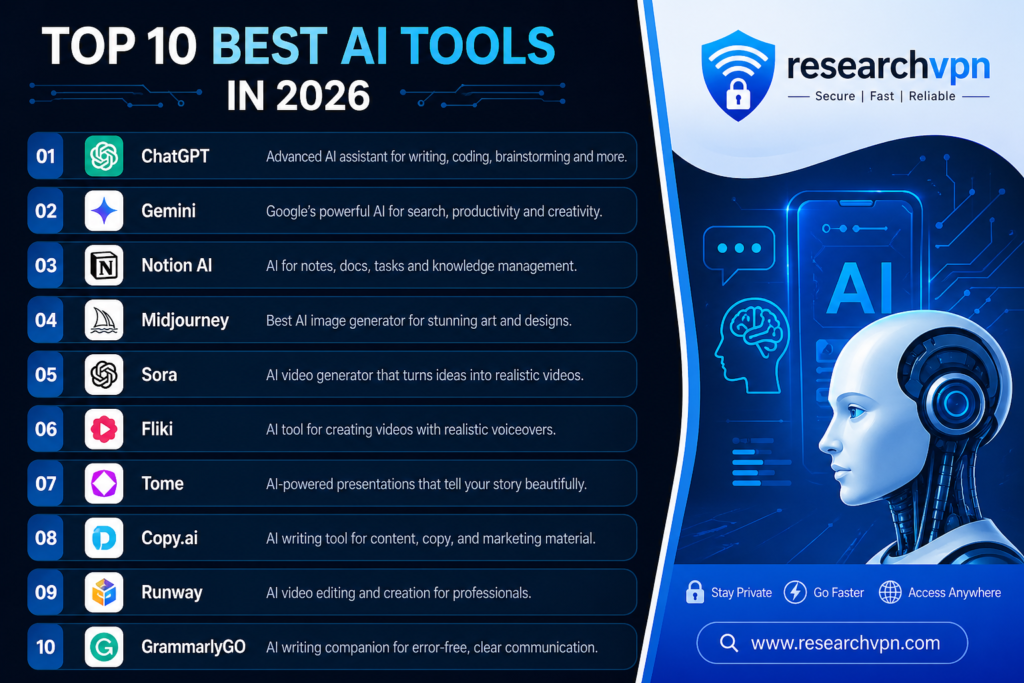
Top 10 Best AI Tools in 2026. One major advantage is time-saving automation. Tasks such as writing emails, creating blog posts, editing videos, or analyzing data can be done much faster. For example, tools like Grammarly improve writing quality instantly, while platforms like Runway simplify complex video editing processes.
Another benefit is cost efficiency. Instead of hiring large teams, businesses can use AI tools to handle customer support, marketing, and design work. This is especially useful for beginners, freelancers, and startups with limited budgets.
AI tools also boost creativity and innovation. Tools like Midjourney allow users to create stunning visuals, while content tools help generate fresh ideas quickly. This makes it easier to experiment and produce high-quality work.
Additionally, AI tools provide 24/7 availability. Unlike humans, they can work anytime without breaks, making them ideal for global businesses and online services.
Finally, they improve accuracy and decision-making by analyzing large amounts of data and providing insights. Overall, AI tools are transforming how people work by making tasks faster, smarter, and more efficient.
How This List Was Put Together
Each tool on this list was chosen based on a few simple criteria:
- Actually useful — does it solve a real problem?
- Beginner-friendly — can someone pick it up without a technical background?
- Value for money — is the free version usable, or is the paid plan worth it?
- Reliable — does it work consistently, not just in demos?
No filler. No tools that sound impressive but deliver mediocre results.
Top 10 Best AI Tools in 2026:- List
1. ChatGPT — Best All-Round Assistant
Best for: Writing, research, brainstorming, answering questions, and coding help
ChatGPT from OpenAI is the tool that most people think of first, and for good reason. It’s the most versatile option on this list. You can use it to draft emails, summarise long documents, write code, explain complicated topics in simple terms, generate ideas, and have a back-and-forth conversation to refine your work.

The GPT-4o model (available on the free plan) is genuinely capable for everyday tasks. The paid plan (ChatGPT Plus at $20/month) gives you access to more powerful models, image generation, and better performance during peak hours.
Practical example: A small business owner uses ChatGPT to draft customer email templates, write product descriptions, and brainstorm social media post ideas — tasks that used to take hours now take 20 minutes.
Pros:
- Extremely versatile — handles dozens of different tasks
- Strong free tier
- Constantly updated with new features
- Works well for non-technical users
Cons:
- Can produce confident but incorrect answers — always verify facts
- The free plan has usage limits during busy periods
- Not ideal for real-time information without web browsing enabled
Pricing: Free / $20 per month (Plus)
2. Midjourney — Best for Image Generation
Best for: Creating original images, illustrations, concept art, marketing visuals
If you need images and you’re not a designer, Midjourney is the most impressive option available. You describe what you want in text, and it generates high-quality, often stunning visuals within seconds. It runs through Discord, which feels unusual at first, but you get used to it quickly.

The images it produces have a distinct quality — detailed, artistic, and often more polished than other image generators. It’s used by graphic designers, marketers, game developers, and content creators worldwide.
Practical example: A blogger who can’t afford a photographer uses Midjourney to create custom header images for every article. The result looks professional and unique — no stock photo feel.
Pros:
- Exceptional image quality
- Wide range of styles (photorealistic, illustrated, painterly, abstract)
- An active community to learn from
- Fast generation — usually under a minute
Cons:
- No free plan anymore (previously had a free trial)
- Runs through Discord, which isn’t intuitive for everyone
- Limited control over very specific details
- Some outputs require several attempts to get right
Pricing: From $10/month (Basic Plan)
3. Grammarly — Best Writing Assistant
Best for: Proofreading, grammar, tone improvement, professional writing
Grammarly has been around longer than most tools on this list, and it still earns its place. It catches grammar mistakes, suggests clearer phrasing, adjusts tone, and now includes rewriting suggestions that go well beyond basic spell-checking.

It works as a browser extension, a desktop app, and integrates with Google Docs, Microsoft Word, and most email clients. You barely notice it’s running — it just quietly improves everything you write.
Practical example: A non-native English speaker uses Grammarly while writing client proposals. It catches awkward phrasing, fixes grammar errors, and suggests more professional word choices — making their writing indistinguishable from a native speaker’s.
Pros:
- Works across almost every platform you write on
- Free version covers the basics well
- Real-time suggestions — no need to manually run checks
- Tone detector helps match writing to context (formal, casual, confident)
Cons:
- Premium plan is expensive at $30/month
- Occasionally suggests changes that alter your intended meaning
- Some suggestions feel overly cautious or generic
- Not a substitute for a human editor on complex documents
Pricing: Free / $12–$30 per month (Premium)
4. GitHub Copilot — Best for Developers
Best for: Writing code, debugging, automating repetitive programming tasks
If you write code for a living — or even as a hobby — GitHub Copilot is one of the most practical tools on this list. It integrates directly into your code editor (VS Code, JetBrains, Neovim) and suggests complete lines or blocks of code as you type, based on what you’re working on.
It’s not just autocomplete. It understands context. If you write a comment describing what a function should do, Copilot will attempt to write the function itself. It also helps with debugging, writing tests, and switching between programming languages.
Practical example: A developer building a web app uses Copilot to generate boilerplate code, write API calls, and debug error messages. Tasks that used to take 30 minutes get done in 5.
Pros:
- Deeply integrated into popular code editors
- Speeds up repetitive coding tasks significantly
- Helpful for learning new languages or frameworks
- Works across dozens of programming languages
Cons:
- $10/month — adds up for hobbyist developers
- Sometimes generates code that looks right but has subtle bugs
- Over-reliance can slow down learning for complete beginners
- Requires a GitHub account
Pricing: $10/month (Individual) / Free for students and open-source contributors
5. Notion AI — Best for Productivity and Note-Taking
Best for: Organising work, writing summaries, managing projects, drafting documents
Notion was already one of the best productivity tools before it added built-in writing assistance. Now it’s even more useful. Notion’s built-in assistant lives inside your workspace — you can ask it to summarise meeting notes, draft a project brief, rewrite a paragraph, or generate a to-do list from a block of text.
The integration is seamless. You’re already in Notion working on your notes or project — you just highlight something and ask for help. No switching between apps.
Practical example: A team uses Notion to manage all their projects. After a long meeting, someone pastes the raw notes into a Notion page and asks it to pull out action items and deadlines. What used to take 20 minutes of manual sorting takes 30 seconds.
Pros:
- Integrated directly into your existing workspace
- No need to copy-paste between tools
- Works well for teams and solo users alike
- Helps with both writing and organisation tasks
Cons:
- Notion itself has a learning curve for new users
- The built-in assistant is an add-on ($8–$10/month extra)
- Not as powerful as a dedicated writing tool for long-form content
- Can feel overwhelming for simple note-taking needs
Pricing: Notion AI add-on from $8/month per member (on top of Notion plan)
6. Runway — Best for Video Editing and Generation
Best for: Video creators, marketers, filmmakers, social media content
Runway is one of the most impressive video tools available right now. It can generate short video clips from text descriptions, remove backgrounds from footage, edit video using simple text commands, and apply cinematic effects that would usually require professional software and hours of work.
It’s particularly popular with content creators who produce a lot of short-form video for YouTube, Instagram, or TikTok and need to move fast without sacrificing quality.
Practical example: A YouTuber uses Runway to remove the background from interview footage without a green screen, add cinematic colour grading, and generate a short b-roll clip — all in under an hour.
Pros:
- Powerful video editing features in a browser-based tool
- Text-to-video generation is genuinely impressive
- Background removal and rotoscoping work well
- Regular updates adding new capabilities
Cons:
- Free plan is very limited (limited credits)
- Video generation quality varies — sometimes needs multiple tries
- Can be slow during peak usage
- Steep learning curve for advanced features
Pricing: Free (limited) / From $15/month (Standard)
7. ElevenLabs — Best for Voice and Audio
Best for: Voiceovers, podcasts, audiobooks, content localisation
ElevenLabs produces some of the most realistic synthetic voices available. You can clone a voice, generate voiceovers from text in dozens of languages, and produce audio content that sounds genuinely human. It’s used by podcasters, video producers, educators, and businesses doing customer-facing audio.
Practical example: A course creator who doesn’t want to record their own voice uses ElevenLabs to generate professional voiceovers for all their lesson videos. The result sounds natural, consistent, and saves hours of recording and editing time.
Pros:
- Industry-leading voice quality
- Supports 30+ languages
- Voice cloning from a short audio sample
- Fast generation — long scripts done in seconds
Cons:
- Voice cloning raises ethical concerns if misused
- Free plan limits monthly character count
- Some voices still have an occasional unnatural cadence
- Pricing scales up quickly for heavy usage
Pricing: Free (limited) / From $5/month (Starter)
8. Perplexity — Best for Research and Search
Best for: Researching topics, finding sources, getting quick and cited answers
Perplexity is a search tool that gives you direct answers instead of a list of links. You ask a question, it searches the web, reads multiple sources, and gives you a concise, cited response. It’s particularly useful for research because every answer comes with links to its sources, so you can verify information easily.
Think of it as what Google would look like if it actually answered your question instead of showing you ten links to sift through.
Practical example: A student researching climate policy asks Perplexity to summarise the main arguments for and against carbon taxes. It pulls from recent academic sources, news outlets, and government sites — with links — in about 10 seconds.
Pros:
- Answers include cited sources — easy to verify
- Faster than manually reading multiple pages
- Good for staying current on fast-moving topics
- Clean, simple interface
Cons:
- Can occasionally misread or misrepresent sources
- Not ideal for creative tasks — it’s a research tool
- A pro plan is needed for more advanced models
- Less effective for highly niche or technical queries
Pricing: Free / $20/month (Pro)
9. Zapier — Best for Workflow Automation
Best for: Connecting apps, automating repetitive tasks, saving time on admin work
Zapier isn’t flashy, but it might be the most practically useful tool on this list for small business owners. It connects over 6,000 apps and automates workflows between them — no coding required. When something happens in one app, Zapier triggers an action in another.
Practical example: Every time a new customer fills out a contact form on your website, Zapier automatically adds them to your email list, sends them a welcome email, creates a task in your project management tool, and logs the contact in your CRM. All without you touching anything.
Pros:
- Connects thousands of apps
- No coding knowledge needed
- Saves significant time on repetitive admin tasks
- Free plan handles basic automations
Cons:
- Can get complex when building multi-step automations
- Paid plans are expensive for heavy users ($49–$69/month)
- Some app integrations are more limited than others
- Debugging failed automations can be frustrating
Pricing: Free (limited) / From $19.99/month (Professional)
10. Descript — Best for Podcast and Video Editing
Best for: Podcasters, video creators, and anyone who edits audio or video content
Descript treats audio and video editing the same way you’d edit a Word document. It transcribes your recording, and then you edit by deleting words from the transcript. Delete a sentence from the text, and it’s deleted from the audio or video. It also removes filler words, silences, and background noise automatically.
For anyone who produces regular video or podcast content, it dramatically reduces editing time.
Practical example: A podcaster records a 90-minute interview, uploads it to Descript, and edits out the “ums,” long pauses, and a 10-minute tangent — all by editing text. What used to take 4 hours of audio editing takes 45 minutes.
Pros:
- Text-based editing is genuinely faster than traditional methods
- Filler word and silence removal works well
- Screen recording built in
- Good collaboration features for teams
Cons:
- Transcription isn’t always 100% accurate
- Free plan limits export quality
- Learning the interface takes some time
- Less powerful than dedicated pro video software (Premiere, Final Cut)
Pricing: Free / From $24/month (Creator)
Quick Comparison Table
| Tool | Best For | Free Plan | Starting Price |
|---|---|---|---|
| ChatGPT | All-round assistant | Yes | $20/month |
| Midjourney | Image generation | No | $10/month |
| Grammarly | Writing and proofreading | Yes | $12/month |
| GitHub Copilot | Coding | No (free for students) | $10/month |
| Notion AI | Productivity | Yes (Notion) | $8/month add-on |
| Runway | Video editing/generation | Yes (limited) | $15/month |
| ElevenLabs | Voice and audio | Yes (limited) | $5/month |
| Perplexity | Research and search | Yes | $20/month |
| Zapier | Workflow automation | Yes | $19.99/month |
| Descript | Podcast/video editing | Yes | $24/month |
FAQs
Which tool is best for someone just starting?
ChatGPT is the best starting point for most people. It’s free, flexible, and handles a wide range of tasks. Once you identify specific needs — design, coding, video — you can add more specialised tools.
Do I need to pay for these tools to get real value?
Not necessarily. ChatGPT, Grammarly, Perplexity, and Zapier all have usable free plans. Start free and upgrade only if you hit the limits regularly.
Can these tools replace employees?
For specific, repetitive tasks — yes, some of them can reduce the need for certain roles. But for anything requiring judgment, creativity, or relationship management, they work best as assistants, not replacements.
Are these tools safe to use for sensitive work?
Most reputable tools have privacy policies that limit how your data is used. That said, avoid pasting confidential client information or sensitive personal data into any of these tools unless you’ve read their data handling policies carefully.
Which tool is best for content creators?
It depends on the type of content. Writers benefit most from ChatGPT and Grammarly. Video creators should look at Runway and Descript. Podcasters will get the most from Descript and ElevenLabs. Image-heavy creators will love Midjourney.
Do I need technical skills to use these tools?
Most of them are designed for non-technical users. ChatGPT, Grammarly, Notion, Perplexity, and ElevenLabs require no technical background. GitHub Copilot is the only one that assumes some coding knowledge.
Conclsion
The tools that will actually make a difference are the ones that fit your specific workflow — not necessarily the ones with the most features or the biggest marketing budgets.
If you’re new to all of this, start with one or two. Get comfortable. Figure out where you’re spending the most time on tasks that feel repetitive or slow. Then look for the tool on this list that targets that exact problem.
The goal isn’t to use ten tools. It’s to use the right ones.

